
With growth set to pick up, a transition from tariff-driven goods inflation to sticky services inflation will forestall any meaningful disinflation progress for another year. This suggests limited scope for Fed easing in 2026.
Risks to our base case center on any unanticipated tightening in financial conditions, including if optimism around the AI investment cycle reverses. We are also attuned to the risk that turnover at the Federal Reserve opens the door to a dovish shift in monetary policy.
While 2025 has been a subpar year for US economic performance, the economy nonetheless displayed remarkable resilience in the face of substantial changes to trade and immigration policy. At time of writing, we estimate the US economy is tracking roughly a 1.8 percent growth rate for the year, only modestly below potential. The economy’s resilience has to a large extent stemmed from the investment boom related to the artificial intelligence (AI) build-out, which has also underpinned strong equity gains that have supported household spending despite a cooling labor market. Healthy household and corporate balance sheets, in the aggregate, have also helped to insulate the economy from shocks.
Figure 1: Aggregate household sector balance sheet remains healthy
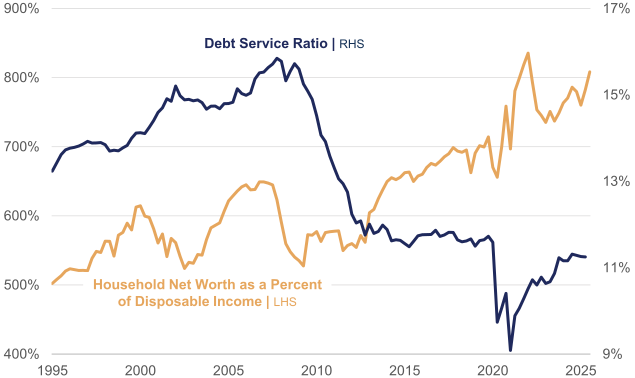
Source: Board of Governors of the Federal Reserve System, MacKay Shields. Debt Service Ratio is total household interest payments as a percentage of disposable income, through Q2 2025. Household Net Worth through Q3 2025 with third quarter estimate based on quarterly change in S&P500 and home prices.
As the calendar turns to 2026, we believe the economy is poised to regain momentum as growth drivers broaden out, resulting in growth a shade under 2.5 percent. Most importantly, fiscal policy is likely to ease as a result of the administration’s signature fiscal package passed this summer. In addition to substantial increases in military and border spending, new household provisions may lead to a strong refund season that increases disposable income, while business investment incentives will support capital expenditures.
Trade policy should also serve as less of a drag going forward, as households and businesses adjust to higher import costs, in part by shifting to lower-cost suppliers. The effective tariff rate on imports should decline over 2026, as the Supreme Court has signaled that it is likely to overturn the administration’s use of the International Emergency Economic Powers Act (IEEPA) to implement broad-based global tariffs. While the administration has other authorities it can use to replicate IEEPA tariffs, these will take time to implement and are likely to be less comprehensive. In addition, overturning IEEPA opens the door to tariff refunds, although the timeline for any such refunds remains highly uncertain. Elimination of IEEPA-based tariffs also deprives the administration of its preferred tool for quickly implementing onerous tariffs in response to any conflicts with foreign governments, as happened on several occasions in 2025. Finally, voter frustration over affordability issues increases the likelihood that the administration will replace the IEEPA tariffs with a new tariff regime that will be less burdensome for households, especially with midterm Congressional elections coming next fall. The midterms also increase the incentive for the administration to seek additional trade deals that lower tariff rates or preclude announced tariffs from being implemented.
In addition to fiscal and trade policy, the administration’s broad efforts at deregulation, including in the financial sector, will likely support business confidence and investment. Finally, financial conditions should remain a tailwind to growth, especially with some additional monetary easing in the pipeline for next year. If the recent decline in primary mortgage rates carries over into next year, residential investment should not be the same drag on GDP growth as it was in 2025 and may even turn into a modest tailwind, especially given the anticipated improvement in overall economic momentum.
With growth picking up next year to a pace moderately above potential, inflation is likely to prove sticky, ending 2026 around 2.75 percent. Tariff-related goods inflation should moderate, but demand-driven services inflation is likely to pick back up alongside an improving economy and stabilization in labor demand. In fact, with immigration and deportation policies continuing to weigh on labor force growth, the second half of 2026 is likely to see the labor market begin to tighten again.
Figure 2: Little disinflation in 2025
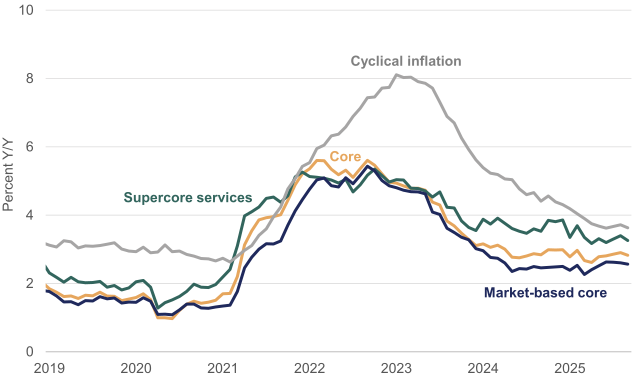
Source: Bureau of Economic Analysis, Federal Reserve Bank of San Francisco, through September 2025. All measures based on the personal consumption expenditures price index and its components. Market-Based core includes only those prices indices for items sold in competitive markets with observable transaction prices. Supercore services excludes owners’ equivalent rent and primary rents from core services. Cyclical inflation is based on those PCE price indices that show sensitivity to the business cycle.
The combination of improving economic momentum, a retightening labor market, and sticky inflation should limit the scope for further monetary easing in 2026. It may be challenging for the incoming Federal Reserve chair to build consensus for significant easing given the concerns of many policymakers about still-elevated inflation. Hence, we have penciled in just one additional 25 basis point rate cut, likely in the first half of the year as concerns over weak labor demand remain the focus of policymakers. With such a move, the policy rate would remain slightly below the FOMC’s estimate of the neutral real policy rate, after adjusting for inflation expectations.
Figure 3: Monetary policy is no longer restrictive
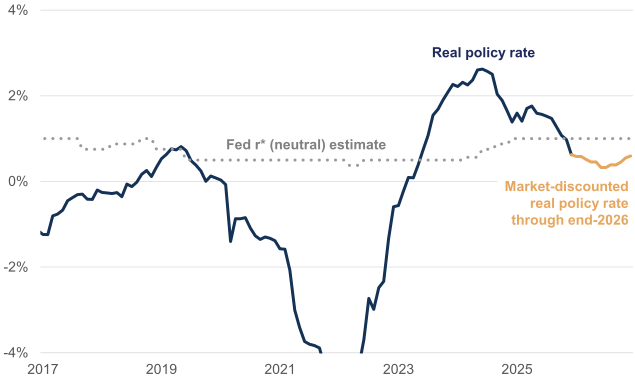
Source: Bloomberg, Federal Reserve, MacKay Shields. Future real policy rate based on OIS futures prices as of December 11, and median expected inflation from Bloomberg Economist Survey.
While our base case for the US economy is constructive, there are several risks we are monitoring. First, financial conditions have been a meaningful tailwind to growth, but are susceptible to reversal. By way of example, most advanced economies have already finished their easing cycles, and markets are increasingly focused on the potential for higher policy rates going forward. Recent data and central bank communications in Japan, Canada, the euro-area and Australia have revealed how sensitive bond markets are to any shift away from the lower-rate narrative of 2025.
The AI boom also poses risks to financial conditions, given that it has served as the main driver of US equity gains this year. Any developments that call into question the future profits that will accrue from AI investment could prompt a sharp reversal in equities that would weigh on household spending, business capex and hiring.
Finally, while the next Federal Reserve chair is likely to be constrained by more hawkish members of the FOMC, there is a distinct possibility that turnover among Federal Reserve Governors opens the door to a more dovish slate of policymakers and overly stimulative policy, especially in 2027. With the real policy rate already slightly below a neutral setting, such an outcome risks delaying a return of inflation to the two percent objective for even longer, and raising serious questions about the Federal Reserve’s commitment to its inflation objective.
IMPORTANT DISCLOSURE
Availability of products and services provided by MacKay Shields may be limited by applicable laws and regulations in certain jurisdictions and this document is provided only for persons to whom this document and the products and services of MacKay Shields may otherwise lawfully be issued or made available. None of the products and services provided by MacKay Shields are offered to any person in any jurisdiction where such offering would be contrary to local law or regulation. This document is provided for information purposes only. It does not constitute investment advice and should not be construed as an offer to buy securities. The contents of this document have not been reviewed by any regulatory authority in any jurisdiction. All investments contain risks and may lose value and these materials do not undertake to explain all of the risks associated with any investment strategy referred to herein. Clients and investors should not invest in any strategy referred to herein unless satisfied that they and/or their representatives have requested and received all information that would enable them to evaluate the merits and risks thereof. Any forward-looking statements speak only as of the date they are made, and MacKay Shields assumes no duty and does not undertake to update forward looking statements. Any opinions expressed are the views and opinions of certain investment professionals at MacKay Shields which are subject to change without notice. There may have been, and may in the future be, changes to the investment personnel responsible for the management of the strategy(ies) described herein, as well as changes to the investment process utilized by such investment personnel. Past performance is not indicative of future results.
At the time of writing, MacKay Shields LLC maintains investments in the securities, issuers and/or companies cited herein. References to such securities, issuers and/or companies for educational and informational purposes only, and are intended to convey factual information and current market conditions. Such names are not intended, nor should they be construed as, a recommendation to buy and sell any individual security.
Information included herein should not be considered predicative of future transactions or commitments made by MacKay Shields LLC nor as an indication of current or future profitability. There is no assurance investment objectives will be met.
Past performance is not indicative of future results.
NOTE TO UK AND EUROPEAN UNION AUDIENCE
This document is intended only for the use of professional investors as defined in the Alternative Investment Fund Manager’s Directive and/or the UK Financial Conduct Authority’s Conduct of Business Sourcebook. To the extent this document has been issued in the United Kingdom, it has been issued by NYL Investments UK LLP, 200 Aldersgate Street, London UK EC1A 4HD, which is authorised and regulated by the UK Financial Conduct Authority. To the extent this document has been issued in the EEA, it has been issued by NYL Investments Europe Limited, 77 Sir John Rogerson's Quay, Block C Dublin D02 VK60 Ireland. NYL Investments Europe Limited is authorized and regulated by the Central Bank of Ireland (i) to act as an alternative investment fund manager of alternative investment funds under the Alternative Investment Fund Managers Directive (Directive 2011/61/EU) and (ii) to provide the services of individual portfolio management, investment advice and the receipt and transmission of orders as defined in Regulation 7(4) of the AIFMD Regulations to persons who meet the definition of “professional client” as set out in the MiFID Regulations. It has passported its license in additional countries in the EEA.
This document only describes capabilities of certain affiliates of New York Life Investments and/or MacKay Shields LLC. No such affiliates will accept subscriptions in any funds not admitted to marketing in your country or provide services to potential customers in your country, including discretionary asset management services, except where it is licensed to do so or can rely on an applicable exemption.
MacKay Shields LLC is a wholly owned subsidiary of New York Life Investment Management Holdings LLC, which is wholly owned by New York Life Insurance Company. "New York Life Investments" is both a service mark, and the common trade name of certain investment advisers affiliated with New York Life Insurance Company. Investments are not guaranteed by New York Life Insurance Company or New York Life Investments.
NOTE TO CANADIAN RECIPIENTS
The information in these materials is not an offer to sell securities or a solicitation of an offer to buy securities in any jurisdiction of Canada. In Canada, any offer or sale of securities or the provision of any advisory or investment fund manager services will be made only in accordance with applicable Canadian securities laws. More specifically, any offer or sale of securities will be made in accordance with applicable exemptions to dealer and investment fund manager registration requirements, as well as under an exemption from the requirement to file a prospectus, and any advice given on securities will be made in reliance on applicable exemptions to adviser registration requirements.
Information included herein should not be considered predicative of future transactions or commitments made by MacKay Shields LLC nor as an indication of current or future profitability. There is no assurance investment objectives will be met. Past performance is not indicative of future results.
NOTE TO JAPANESE RECIPIENTS
In Japan, this is issued by New York Life Investment Management Asia Limited (Financial Instruments Business Operator, Kanto Local Finance Bureau (FIBO) No. 2964, Member of Japan Investment Advisers Association and Type 2 Financial Instruments Firms Association) for institutional investors only. As costs and/or fees to be borne by investors vary depending on circumstances such as products, services, investment period and market conditions, the total amount nor the calculation methods cannot be disclosed in advance. All investments involve risks, including market fluctuation and investors may lose the principal amount invested. Investors should obtain and read the prospectus and/or information set forth in Article 37-3 of the Financial Instruments and Exchange Act carefully before making investment decisions.
MacKay Shields LLC is a wholly owned subsidiary of New York Life Investment Management Holdings LLC, which is wholly owned by New York Life Insurance Company. "New York Life Investments" is both a service mark, and the common trade name of certain investment advisers affiliated with New York Life Insurance Company. Investments are not guaranteed by New York Life Insurance Company or New York Life Investments.
SOURCE INFORMATION
“Bloomberg® ”, “Bloomberg Indices® ”, Bloomberg Fixed Income Indices, Bloomberg Equity Indices and all other Bloomberg indices referenced herein are service marks of Bloomberg Finance L.P. and its affiliates, including Bloomberg Index Services Limited (“BISL”), the administrator of the indices (collectively, “Bloomberg”) and have been licensed for use for certain purposes by MacKay Shields LLC (“MacKay Shields”). Bloomberg is not affiliated with MacKay Shields, and Bloomberg does not approve, endorse, review, or recommend MacKay Shields or any products, funds or services described herein. Bloomberg does not guarantee the timeliness, accurateness, or completeness of any data or information relating to MacKay Shields or any products, funds or services described herein.
Subscribe to get MacKay Shields insights delivered to your inbox.
Related Thought Leadership